
ARPA-H Investor Catalyst Hub Informs New AI Medical Imaging Program
July 11, 2025—Artificial intelligence (AI) has incredible potential to help interpret the rapidly growing volume of imaging exams to treat and diagnose patients. However, lack of high-quality and accessible data to train the models can introduce bias and inaccuracy. Data gaps can limit the clinical benefits and delay U.S. Food and Drug Administration (FDA) clearance or pre-market authorization of new software and devices.
To speed progress of robust and trustworthy technology, the Advanced Research Projects Agency for Health (ARPA-H) launched the ImagiNg Data EXchange (INDEX) program. This program aims to create a platform that increases the number, type, and quality of images for AI tool developers, which they need to help meet the standards for regulatory approval.
ARPA-H tapped the Investor Catalyst (IC) Hub expert network, which spans over 600 institutions nationwide, to help the INDEX team better understand the current data landscape and create a program that would meet user needs. The IC Hub’s network survey offered a 360-degree perspective from medical imaging data providers, managers, and users on how to build an effective platform to advance AI and machine learning (ML) applications. These findings provided ARPA-H with key program areas covering data security, affordability, interoperability, and demographic and clinical representation.

Technical Insights To Break Through Barriers
Over 100 institutions responded to the IC Hub medical imaging data marketplace network survey. The survey revealed an audience eager to help shape this much-needed asset, including many major radiological associations nationwide. IC Hub spokes and other stakeholders from academia, government, nonprofits, and private companies participated, with 10% of responses coming from Fortune 500 companies.
Among the valuable perspectives shared in the survey was spoke member Datavant. This software company maintains the largest health data exchange in the country. Datavant’s head of public sector partnerships, Nick Messina, emphasized, “The network survey went deeper than any other known publication on the challenges and potential upside outcomes of having imaging data readily available for research, and we highly valued that due to our ability to carry this message forward within our ecosystem.”
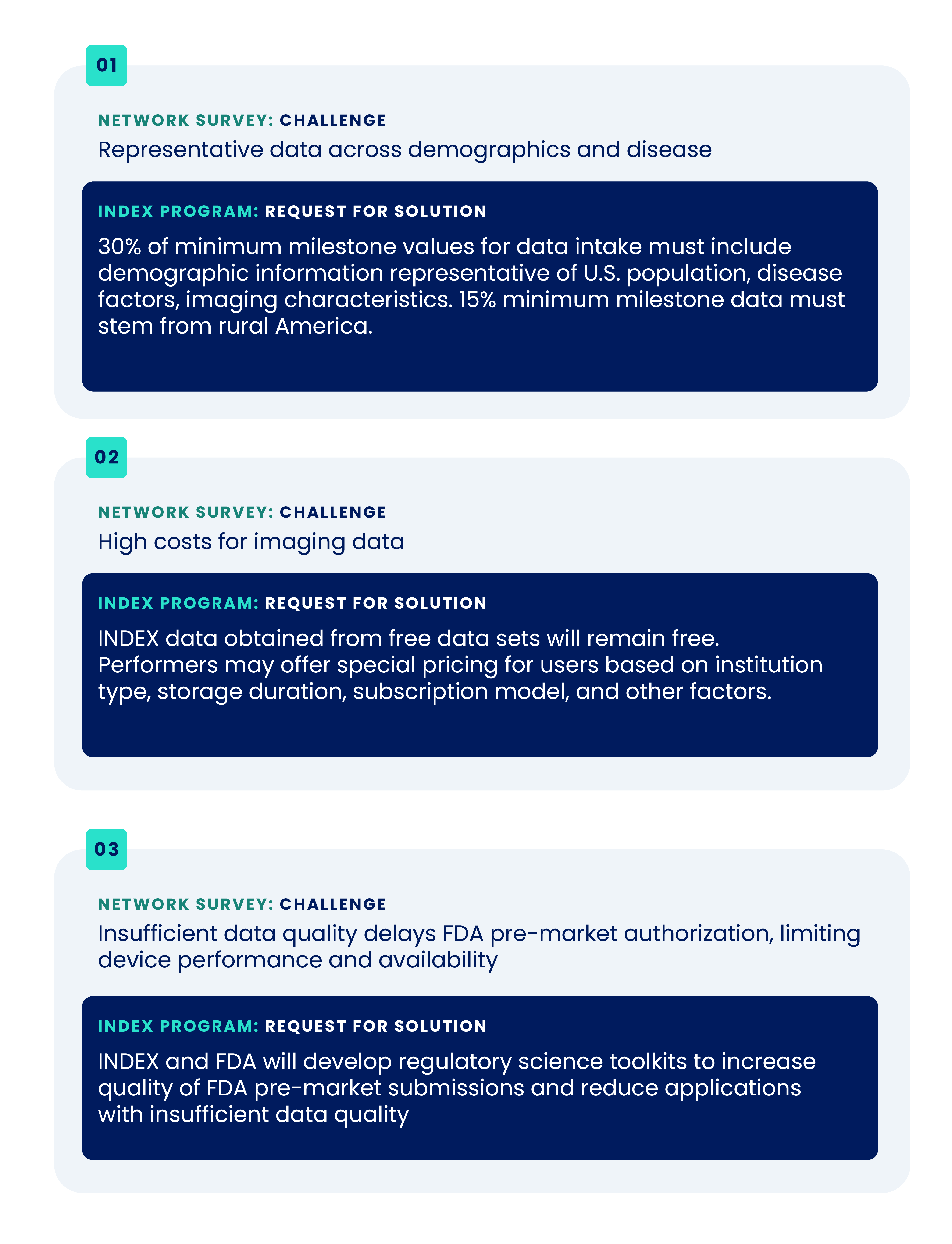
Respondents identified key data roadblocks, including security and compliance, high costs, and delays in obtaining imaging data, as well as interoperability with standard tools and platforms, and representative data across demographics and diseases. Among these issues, respondents cited lack of representation in data as a top reason for delay and project abandonment, including across racial, socioeconomic, geographic, rare disease, and age groups.
Developers need representative data to generate a proof of concept for valid AI/ML models. They need even more images to transform that proof of concept into a product ready for the public. One respondent mentioned needing thousands of mammograms since cancer will only appear in four to five images out of 1,000 cases. Survey respondents emphasized that to speed up AI/ML-related submissions, the marketplace will need to have large enough datasets available to support a full FDA submission. These findings led to key opportunities and gaps in the market that the INDEX program is now working to address.
Idea to Action: The INDEX Program
Equipped with a roadmap from the IC Hub network, the INDEX program areas represent critical needs identified in the network survey, including milestones for data representation and affordable pricing options. The survey also identified several desirable service areas that INDEX will want to support, which will meet a variety of user needs and contribute to the long-term sustainability of the platform. These service areas include data aggregation, classification, annotation, de-identification, deduplication, metadata services, and additional functionalities.
To help performers efficiently move their innovations through FDA approval, INDEX will have data available to support end-to-end device development. In collaboration with INDEX, the FDA will develop regulatory science toolkits for performers. These toolkits will help performers align their innovation with FDA data quality, data diversity, data analytics, and data usage standards. This project will increase the quality of premarket submissions and ensure performers have sufficient data to develop effective technologies.
Activating the Investor Catalyst Hub Network
The new INDEX program showcases how the IC Hub transforms market insights from the network to accelerate the development of programs that catalyze innovative healthcare solutions. Joining the IC Hub network provides experts and innovators with the unique opportunity to inform ARPA-H program and service design.
On their experience engaging in the network survey as a spoke, American College of Radiology Executive Vice President of the Center of Research and Innovation Charles Apgar shared: “It is great to see our feedback reflected in the INDEX program. A data exchange like this could help lead to improved imaging tools for research that would be incredibly valuable for radiologists and patients.”
Interested in becoming a spoke? Apply to join a nationwide network collectively working to speed the commercialization of groundbreaking health innovations.